
Saturday, November 3, 2018

Exposure to Radiofrequency Radiation Emitted from Common Mobile Phone Jammers Alters the Pattern of Muscle Contractions: an Animal Model Study


Image result for Exposure to Radiofrequency Radiation Emitted from Common Mobile Phone Jammers Alters the Pattern of Muscle Contractions: an Animal Model Study


Abstract

Introduction


The rapid growth of wireless communication technologies has caused public concerns regarding the biological effects of electromagnetic radiations on human health. Some early reports indicated a wide variety of non-thermal effects of electromagnetic radiation on amphibians such as the alterations of the pattern of muscle extractions. This study is aimed at investigating the effects of exposure to radiofrequency (RF) radiation emitted from mobile phone jammers on the pulse height of contractions, the time interval between two subsequent contractions and the latency period of frog’s isolated gastrocnemius muscle after stimulation with single square pulses of 1V (1 Hz).


Materials and Methods


Frogs were kept in plastic containers in a room. Animals in the jammer group were exposed to radiofrequency (RF) radiation emitted from a common Jammer at a distance of 1m from the jammer’s antenna for 2 hours while the control frogs were only sham exposed. Then animals were sacrificed and isolated gastrocnemius muscles were exposed to on/off jammer radiation for 3 subsequent 10 minute intervals. Isolated gastrocnemius muscles were attached to the force transducer with a string. Using a PowerLab device (26-T), the pattern of muscular contractions was monitored after applying single square pulses of 1V (1 Hz) as stimuli.


Results


The findings of this study showed that the pulse height of muscle contractions could not be affected by the exposure to electromagnetic fields. However, the latency period was effectively altered in RF-exposed samples. However, none of the experiments could show an alteration in the time interval between two subsequent contractions after exposure to electromagnetic fields.


Conclusion


These findings support early reports which indicated a wide variety of non-thermal effects of electromagnetic radiation on amphibians including the effects on the pattern of muscle extractions.


Keywords: Non-Ionizing Radiation, Radiofrequency (RF), Electromagnetic Fields, GSM Mobile Phone, Muscle Contractions, Frog


Go to:


Introduction


The fast-growing telecommunication and wireless technologies and more dependence to these communication devices have led to higher levels of exposure to electromagnetic radiations emitted by different sources such as cellular phones and their base stations. Mobile phone jammers are devices that emit radiofrequency radiation in the same frequencies that mobile phones operate to disable signaling in places where silence is valued or where information quarantine measures are required such as examination halls, prisons, or military centers. Rapid growth of wireless communication technologies, has led to public concern regarding the biological effects of electromagnetic radiations on human health. Understanding the effects of exposure of humans or higher animals to electromagnetic fields (EMFs) is clearly associated with the understanding of the targets of these fields in exposed cells and tissues. However, it is still unclear what these targets are and how they may cause complex biological responses to very low-energy non-ionizing radiations. It is puzzling that low-energy photons (in energy ranges which usually cannot individually alter the chemistry of the cell) can lead to non-thermal effects in the irradiated cells [1]. The function of brain and nervous systems is based on using electrical signals. Hence, brain and nervous systems can be particularly vulnerable to low frequency EMFs and the electric fields and currents which are induced during exposure. It is worth mentioning that some of the studies performed on animal models have shown that the bioeffects of exposure to electromagnetic fields can be mediated by the nervous system. These studies have revealed that several biochemical changes in nervous systems (alterations in water, oxygen, calcium and some regulatory peptides such as serotonin and histamine) are associated with exposure to electromagnetic fields.


Over the past years, our laboratory has focused on studying the health effects of exposure of laboratory animals and humans to some common and/or occupational sources of electromagnetic fields such as mobile phones [2-9] and their base stations [10], mobile phone jammers [11], laptop computers [12], radars [3], dentistry cavitrons [13] and MRI [14, 15]. This study is aimed at investigating the effects of exposure to radiofrequency radiation emitted by a mobile jammer on the pulse height of contractions, the time interval between two subsequent contractions and the latency period of frog’s isolated gastrocnemius muscle after stimulation with single square pulses of 1V (1 Hz)


Go to:


Material and Methods

Animals


Frogs of both sexes (20-30 g) were obtained from Animal Lab of the Physiology Department, SUMS. Animals were kept in plastic containers in a room (20 ± 1 °C) for one week before the experiments. The tap water in the plastic containers was changed 2 times a week.


Exposure


Control frogs were kept in special cages during the sham exposure phases, while the jammer group was exposed to radiofrequency (RF) radiation emitted from a common Jammer at a distance of 1m from the jammer’s antenna for 2 hours. Isolated gastrocnemius muscles, in the next stage, were exposed to on/off jammer radiation for 3 subsequent 10 minute intervals.


Experiment Setup


Frogs were double pithed using a needle. Then the skin over the gastrocnemius muscle and its distal tendon was removed. Isolated gastrocnemius muscles were attached to the force transducer with a string. Nerve and muscle stimulations were performed separately. Using a PowerLab device (26-T), the pattern of muscular contractions was monitored after applying single square pulses of 1V (1 Hz) as stimuli. The pulse height of contractions, the time interval between two subsequent contractions and the delta (latency; the time interval between stimulus and response) were measured.


Statistical Analysis


All statistical analyses were performed using Statistical Package for the Social Sciences (SPSS, ver: 19.0), and the comparisons of the means of the physiological parameters were conducted using non-parametric Kruskal Wallis and Mann-Whitney tests. The statistical significance was considered as P<0 .05.="" p="">

Go to:


Results

Muscle Stimulation


Table 1 shows the pulse height of contractions, the time interval between two subsequent contractions and the latency period in non-exposed control group after in-vivo sham-exposure, and when isolated gastrocnemius muscles were sham-exposed to mobile jammer radiation. As it was expected, no statistically significant differences were observed in different sham exposure phases.


Table 1


The pulse height of contractions, the time interval between two subsequent contractions and the latency period in non-exposed Mobile Phone Jammers group after in-vivo sham-exposure, and when isolated gastrocnemius muscles were sham-exposed to mobile phone Jammers (muscle stimulation).


Control
Sample size
Phase I
Phase II
Phase III
Phase IV
p-value
After in vivo
sham-exposure
After 10 min
sham-exposure
After 10 min off
After 10 min
sham-exposure
Pulse height of
contraction(mV)
10 0.324 ± 0.180 0.295 ± 0.163 0.316 ± 0.147 0.304 ± 0.140 0.68
Time interval(sec) 10 1 ± 0.001 1 ± 0.0008 0.999 ± 0.001 1 ± 0.001 0.083
Latency
period(sec)
10 0.004 ± 0.001 0.004 ± 0.002 0.004 ± 0.001 0.004 ± 0.001 0.79


Open in a separate window


The pulse height of contractions, the time interval between two subsequent contractions and the latency period in moboile phone jammer group after in-vivo exposure, and when isolated gastrocnemius muscles were exposed to mobile jammer radiation are summarized in Table 2. We observed a statistically significant difference among the latency periods in different off/on exposure phases (P=0.0001). The mean (±SD) latency period after a 2 hour in-vivo exposure was 0.006 ± 0.001 seconds but when isolated gastrocnemius muscles were in 10 min on/off/on exposure phases, the latencies were 0.009 ± 0.001, 0.004 ± 0.001, 0.008 ± 0.001 seconds, respectively.


Table 2


Panel A: The pulse height of contractions, the time interval between two subsequent contractions and the latency period in jammer group after in-vivo exposure, and when isolated gastrocnemius muscles were exposed to Mobile Phone Jammers (muscle stimulation). Panel B: Pairwise comparisons of the latency period.


Panel A
                 
Jammer Sample size Phase I   Phase II   Phase III Phase IV p-value  
After in vivo
exposure
  After 10 min
exposure
  After 10 min
off
After 10 min
exposure
 
Magnitude of
contraction(mV)
10 0.407 ± 0.208   0.446 ± 0.202   0.473 ± 0.166 0.443± 0.157 0.54  
Time interval(sec) 10 1 ± 0.0007   1 ± 0.0009   1 ± 0.0008 1 ± 0.001 0.67  
Latency
period(sec)
10 0.006 ± 0.001   0.009 ± 0.001   0.004 ± 0.001 0.0077 ± 0.001 0.0001  
Panel B                  
Latency period Phase I Phase II   0.02          
Phase III   0.20          
Phase IV   0.053          
Phase II Phase III   0.03          
Phase IV   0.15          
Phase III Phase IV   0.03          


Open in a separate window


The inter-group comparison could not show any statistically significant differences in pulse height and time interval between two subsequent contractions (Figure 1-​-2).However,2).However, a statically significant difference was found in the latency (Figure 3).


Open in a separate window


Figure 1


Pulse height of contraction (ph) – Muscle Stimulation (Error bars indicate SE)


Figure 2


The time interval between two subsequent contractions (distance) – Muscle Stimulation (Error bars indicate SE)


Open in a separate window


Figure 3


The latency period – Muscle Stimulation (Error bars indicate SE)


Nerve Stimulation


Table 3 shows the pulse height of contractions, the time interval between two subsequent contractions and the latency period in non-exposed control group after in-vivo sham-exposure, and when isolated gastrocnemius muscles were sham-exposed to mobile jammer radiation. In contrast with what was expected, a statistically significant difference was observed for the pulse height of contractions in different sham exposure phases (P=0.033).


Table 3


Panel A: The pulse height of contractions, the time interval between two subsequent contractions and the latency period in non-exposed control group after in-vivo sham-exposure, and when isolated gastrocnemius muscles were sham-exposed to Mobile Phone Jammers (Nerve stimulation). Panel B: Pairwise comparisons of the pulse height of contractions.


Panel A
                 
Control Sample size Phase I   Phase II   Phase III   Phase IV p-value
After in vivo
sham-exposure
  After 10 min
sham-exposure
  After
10 min off
  After 10 min
sham-exposure
Pulse height of
contraction(mV)
10 0.447 ± 0.18   0.424 ± 0.187   0.368 ± 0.189   0.353 ± 0.208 0.033
Time interval(sec) 10 0.999 ± 0.001   1 ± 0.001   1 ± 0.001   1 ± 0.001 0.69
Latency
period(sec)
10 0.004 ± 0.001   0.005 ± 0.001   0.005 ± 0.001   0.005 ± 0.001 0.093
Panel B                  
Pulse height of contraction Phase I Phase II   0.88          
Phase III   0.12          
Phase IV   0.12          
Phase II Phase III   0.09          
Phase IV   0.04          
Phase III Phase IV   0.39          


Open in a separate window


The pulse height of contractions, the time interval between two subsequent contractions and the latency period in mobile jammer group after in-vivo exposure, and when isolated gastrocnemius muscles were exposed to mobile jammer radiation are summarized in Table 4. In this part of the experiment, we observed only a statistically significant difference among the latency periods in different off/on exposure phases (P=0.0001). The mean (±SD) latency period after a 2 hour in-vivo exposure was 0.006 ± 0.001 seconds but when isolated gastrocnemius muscles were in 10 min on/off/on exposure phases, the latencies were 0.009 ± 0.001, 0.006 ± 0.001, 0.009 ± 0.001 seconds, respectively. The inter-group comparison could not show any statistically significant differences in pulse height and time interval between two subsequent contractions (Figure 4-​-55).


Table 4


Panel A: The pulse height of contractions, the time interval between two subsequent contractions and the latency period in jammer group after in-vivo exposure, and when isolated gastrocnemius muscles were exposed to Mobile Phone Jammers (Nerve stimulation). Panel B: Pairwise comparisons of the latency period.


Panel A
                 
Jammer Sample size Phase I   Phase II   Phase III Phase IV p-value  
After in
vivo exposure
  After 10 min
exposure
  After 10 min
off
After 10 min
exposure
 
Magnitude of
contraction(mV)
10 0.444 ± 0.212   0.460 ± 0.248   0.487± 0.177 0.434 ± 0.183 0.056  
Time interval(sec) 10 1 ± 0.001   1 ± 0.001   1 ± 0.0005 1 ± 0.001 0.72  
Latency
period(sec)
10 0.006 ± 0.001   0.009 ± 0.001   0.006 ± 0.001 0.009 ± 0.001 0.0001  
Panel B                  
Latency period Phase I Phase II   0.02          
Phase III   0.17          
Phase IV   0.02          
Phase II Phase III   0.04          
Phase IV   0.86          
Phase III Phase IV   0.04          


Open in a separate window


Figure 4


Pulse height of contraction (ph) – Nerve Stimulation (Error bars indicate SE)


Figure 5


The time interval between two subsequent contractions – Nerve Stimulation (Error bars indicate SE)


However, a statically significant difference was found in the latency (Figure 6).


Figure 6


The latency period– Nerve Stimulation (Error bars indicate SE)


Table 5 shows the calculated SAR values (W/kg) for 3G, CDMA, DCS and GSM jammer’s antenna.


Table 5


Calculated SARs (W/kg).


Distance
3G
 
CDMA
 
DCS
 
GSM
 
SAR
(W/kg)
 
SAR
(W/kg)
 
SAR
(W/kg)
 
SAR
(W/kg)
 
(muscle)
(nerve)
(muscle)
(nerve)
(muscle)
(nerve)
(muscle)
(nerve)
1 meter 0.017 0.010 0.033 0.02 0.038 0.024 0.052 0.033


Go to:


Discussion


In this study it is revealed that the pulse height of contractions in frog’s gastrocnemius muscle cannot be affected by the exposure to electromagnetic fields. However, our experiments showed that the latency period can be easily altered by the irradiation. However, none of the experiments could show an alteration in the time interval between two subsequent contractions after exposure to electromagnetic fields. The general pattern which could be observed in these experiments indicates that exposure to electromagnetic fields usually increase the latency period. To the best of our knowledge, this is the first report that shows the role of exposure to electromagnetic fields generated by mobile phone jammers on the pulse height of contractions, time interval between two subsequent contractions and the latency period in frog’s gastrocnemius muscle after applying single square pulses of 1V (1 Hz) as stimuli.


Generally speaking our results are in line with numerous reports which showed that a wide variety of cells including epithelial, endothelial and epidermal cells, cardiac muscle cells, fibroblasts, yeast, E. coli, developing chick eggs, and dipteran cells respond to EMF, both in vivo and in vitro [16]. It has been reported that tissue cultured cells are less susceptible to the effects of EMF, possibly due to this point that immortalized cells have been altered in an important manner to enable them to live limitlessly in unnatural laboratory conditions. However, our results are in contrast with some old reports which indicated that exposure of the isolated frog sciatic nerves, cat saphenous nerves, rabbit vagus nerves, superior cervical ganglia, and rat diaphragm muscles to 2450 MHz microwave radiation cannot change the characteristics of nerves or muscles exposed to CW specific absorption rate (SAR) of 0.3-1500 W/kg and pulsed peak SAR of 0.3-220 kW/kg [17].


Our findings support early reports which indicated the non-thermal effects of electromagnetic radiation on amphibians [18, 19]. Some early reports have indicated that exposure of amphibians to electromagnetic fields may cause teratogenic effects [20]. On the other hand, it is reported that common frogs (Rana temporaria L.) developed under electromagnetic field shows a higher rate of mortality, slow and less synchronously development, allergies, and alterations in their blood counts [21].


It has been also reported that exposure of frogs to electromagnetic radiation with power densities of 30–60 mWcm-2 caused a heart rhythm change, possibly due to activation of the nervous system. Furthermore, an increase in the heart rate and arrhythmia after irradiation of toad hearts with pulses of 1425 MHz at a power density of 0.6 mWcm-2, has been reported [18]. Interestingly, in Spain A. Balmori in a paper entitled "The incidence of electromagnetic pollution on the amphibian decline: Is this an important piece of the puzzle?" published in the journal Toxicological and Environmental Chemistry in 2006 reports the possible association of exposure to microwave radiation and the global disappearance of frogs [22].


Go to:


Acknowledgment


This study was supported by the Ionizing and Non-ionizing Radiation Protection Research Center (INIRPRC), Shiraz University of Medical Sciences (SUMS), Shiraz, Iran.


Conflict of Interest: None Declared


Go to:


References


1. Pall ML. Electromagnetic fields act via activation of voltage-gated calcium channels to produce beneficial or adverse effects. J Cell Mol Med. 2013;17:958–65. doi.org/10.1111/jcmm.12088. PubMed PMID: 23802593. PubMed PMCID: 3780531. [PMC free article] [PubMed]


2. Mortazavi SM, Motamedifar M, Namdari G, Taheri M, Mortazavi AR, Shokrpour N. Non-linear adaptive phenomena which decrease the risk of infection after pre-exposure to radiofrequency radiation. Dose Response. 2014;12:233–45. doi.org/10.2203/dose-response.12-055.Mortazavi. PubMed PMID: 24910582. PubMed PMCID: 4036396. [PMC free article] [PubMed]


3. Mortazavi SM, Taeb S, Dehghan N. Alterations of visual reaction time and short term memory in military radar personnel. Iran J Public Health. 2013;42:428–35. PubMed PMID: 23785684. PubMed PMCID: 3684731. [PMC free article] [PubMed]


4. Mortazavi SM, Rouintan MS, Taeb S, Dehghan N, Ghaffarpanah AA, Sadeghi Z, et al. Human short-term exposure to electromagnetic fields emitted by mobile phones decreases computer-assisted visual reaction time. Acta Neurol Belg. 2012;112:171–5. doi.org/10.1007/s13760-012-0044-y. PubMed PMID: 22426673. [PubMed]


5. Mortazavi S, Mosleh-Shirazi M, Tavassoli A, Taheri M, Mehdizadeh A, Namazi S, et al. Increased Radioresistance to Lethal Doses of Gamma Rays in Mice and Rats after Exposure to Microwave Radiation Emitted by a GSM Mobile Phone Simulator. Dose Response. 2013;11:281–92. doi.org/10.2203/dose-response.12-010.Mortazavi. PubMed PMID: 23930107. PubMed PMCID: 3682203. [PMC free article] [PubMed]


6. Mortazavi S, Mosleh-Shirazi M, Tavassoli A, Taheri M, Bagheri Z, Ghalandari R, et al. A comparative study on the increased radioresistance to lethal doses of gamma rays after exposure to microwave radiation and oral intake of flaxseed oil. Iranian J Radiation Res. 2011;9:9–14.


7. Mortavazi S, Habib A, Ganj-Karami A, Samimi-Doost R, Pour-Abedi A, Babaie A. Alterations in TSH and Thyroid Hormones following Mobile Phone Use. Oman Med J. 2009;24:274–8. doi.org/10.5001/omj.2009.56. PubMed PMID: 22216380. PubMed PMCID: 3243874. [PMC free article] [PubMed]


8. Mortazavi SM, Daiee E, Yazdi A, Khiabani K, Kavousi A, Vazirinejad R, et al. Mercury release from dental amalgam restorations after magnetic resonance imaging and following mobile phone use. Pak J Biol Sci. 2008;11:1142–6. doi.org/10.3923/pjbs.2008.1142.1146. PubMed PMID: 18819554. [PubMed]


9. Mortazavi SM, Ahmadi J, Shariati M. Prevalence of subjective poor health symptoms associated with exposure to electromagnetic fields among university students. Bioelectromagnetics. 2007;28:326–30. doi.org/10.1002/bem.20305. PubMed PMID: 17330851. [PubMed]


10. Mortazavi S. Safety issue of mobile phone base stations. J Biomed Phys Eng. 2013;3:1–2.


11. Roth J, Schweizer P, Guckel C. Basis of radiation protection. Schweiz Med Wochenschr. 1996;126:1157–71. PubMed PMID: 8711464. [PubMed]


12. Mortazavi SMJ, Tavassoli A, Ranjbari F, Moammaiee P. Effects of laptop computers’ electromagnetic field on sperm quality. J Reproduction & Infertility. 2010;11:251–58.


13. Mortazavi SM, Vazife-Doost S, Yaghooti M, Mehdizadeh S, Rajaie-Far A. Occupational exposure of dentists to electromagnetic fields produced by magnetostrictive cavitrons alters the serum cortisol level. J Nat Sci Biol Med. 2012;3:60–4. doi.org/10.4103/0976-9668.95958. PubMed PMID: 22690053. PubMed PMCID: 3361780. [PMC free article] [PubMed]


14. Mortazavi SM, Daiee E, Yazdi A, Khiabani K, Kavousi A, Vazirinejad R, et al. Mercury release from dental amalgam restorations after magnetic resonance imaging and following mobile phone use. Pak J Biol Sci. 2008;11:1142–6. doi.org/10.3923/pjbs.2008.1142.1146. PubMed PMID: 18819554. [PubMed]


15. Mortazavi SM, Neghab M, Anoosheh SM, Bahaeddini N, Mortazavi G, Neghab P, et al. High-field MRI and mercury release from dental amalgam fillings. Int J Occup Environ Med. 2014;5:101–5. PubMed PMID: 24748001. [PubMed]


16. Blank M, Goodman R. Electromagnetic fields stress living cells. Pathophysiology. 2009;16:71–8. doi.org/10.1016/j.pathophys.2009.01.006. PubMed PMID: 19268550. [PubMed]


17. Chou C-k, Guy AW. Effects of electromagnetic fields on isolated nerve and muscle preparations. Microwave Theory and Techniques, IEEE Transactions on. 1978;26:141–7. doi.org/10.1109/TMTT.1978.1129334.


18. Frey AH, Seifert E. Pulse modulated UHF energy illumination of the heart associated with change in heart rate. Life Sciences. 1968;7:505–12. doi.org/10.1016/0024-3205(68)90068-4.


19. Neurath PW. High gradient magnetic field inhibits embryonic development of frogs. Nature. 1968;219:1358–9. doi.org/10.1038/2191358a0. PubMed PMID: 5692604. [PubMed]


20. Levengood WC. A new teratogenic agent applied to amphibian embryos. J Embryol Exp Morphol. 1969;21:23–31. PubMed PMID: 5765792. [PubMed]


21. Grefner N, Yakovleva T, Boreisha I. Effects of electromagnetic radiation on tadpole development in the common frog (Rana temporaria L.) Russian J Ecology. 1998;29:133–4.


22. Balmori A. The incidence of electromagnetic pollution on the amphibian decline: Is this an important piece of the puzzle? Toxicological & Environmental Chemistry. 2006;88:287–99. doi.org/10.1080/02772240600687200.


SOURCE:


https://www.ncbi.nlm.nih.gov/pmc/articles/PMC4576874/

Watch the film the Israel lobby didn’t want you to see


Image result for Watch the film the Israel lobby didn’t want you to see


The Electronic Intifada has obtained a complete copy of The Lobby – USA, a four-part undercover investigation by Al Jazeera into Israel’s covert influence campaign in the United States.


It is today publishing the first two episodes. The Paris-based Orient XXI has published the same episodes with French subtitles.


The film was made by Al Jazeera during 2016 and was completed in October 2017.


But it was censored after Qatar, the gas-rich Gulf emirate that funds Al Jazeera, came under intense Israel lobby pressure not to air the film.


Although Al Jazeera’s director-general claimed last month that there were outstanding legal issues with the film, his assertions have been flatly contradicted by his own journalists.


In March, The Electronic Intifada was the first to report on any of the film’s specific content. We followed this in August by publishing the first extract of the film, and shortly after Max Blumenthal at the Grayzone Project released others.


Since then, The Electronic Intifada has released three other extracts, and several other journalists have watched the entire film and written about it – including Alain Gresh and Antony Loewenstein.


Now The Electronic Intifada can reveal for the first time that it has obtained all four parts of the film.


You can watch the first two parts in the video embeds above and below.


To get unprecedented access to the Israel lobby’s inner workings, undercover reporter "Tony" posed as a pro-Israel volunteer in Washington.


The resulting film exposes the efforts of Israel and its lobbyists to spy on, smear and intimidate US citizens who support Palestinian human rights, especially BDS – the boycott, divestment and sanctions movement.


It shows that Israel’s semi-covert black-ops government agency, the Ministry of Strategic Affairs, is operating this effort in collusion with an extensive network of US-based organizations.


These include the Israel on Campus Coalition, The Israel Project and the Foundation for Defense of Democracies.


Censored by Qatar


The film was suppressed after the government of Qatar came under intense pressure not to release it – ironically from the very same lobby whose influence and antics the film exposes.


Clayton Swisher, Al Jazeera’s head of investigations, revealed in an article for The Forward in March that Al Jazeera had sent more than 70 letters to individuals and organizations who appear in or are discussed in the film, providing them with an opportunity to respond.


Only three did so. Instead, pro-Israel groups have endeavored to suppress the film that exposes the lobby’s activities.


In April, Al Jazeera’s management was forced to deny a claim by the hard-right Zionist Organization of America that the film had been canceled altogether.


In June, The Electronic Intifada learned that a high level source in Doha had said the film’s indefinite delay was due to "national security" concerns of the Qatari government.


Covert action


As revealed in a clip published by The Electronic Intifada earlier this week, the film shows Julia Reifkind – then an Israeli embassy employee – describing her typical work day as "mainly gathering intel, reporting back to Israel … to report back to the Ministry of Foreign Affairs, the Ministry of Strategic Affairs."


She discusses the Israeli government "giving our support" to front groups "in that behind-the-scenes way."


Reifkind also admits to using fake Facebook profiles to infiltrate the circles of Palestine solidarity activists on campus.


The film also reveals that US-based groups coordinate their efforts directly with the Israeli government, particularly its Ministry of Strategic Affairs.


Run by a former military intelligence officer, the ministry is in charge of Israel’s global campaign of covert sabotage targeting the BDS movement.


The film shows footage of the very same ex-military intelligence officer, Sima Vaknin-Gil, claiming to have mapped Palestinian rights activism "globally. Not just the United States, not just campuses, but campuses and intersectionality and labor unions and churches."


She promises to use this data for "offense activity" against Palestine activists.


Jacob Baime, executive director of the Israel on Campus Coalition, claims in the undercover footage that his organization uses "corporate level, enterprise-grade social media intelligence software" to gather lists of Palestine-related student events on campus, "generally within about 30 seconds or less" of them being posted online.


Baime also admits on hidden camera that his group "coordinates" with the Israeli Ministry of Strategic Affairs.


Baime states that his researchers "issue early warning alerts to our partners" – including Israeli ministries.


Baime’s colleague Ian Hersh admits in the film to adding Israel’s "Ministry of Strategic Affairs to our operations and intelligence brief."


"Psychological warfare"


Baime describes how his group has used anonymous websites to target activists.


"With the anti-Israel people, what’s most effective, what we’ve found at least in the last year, is you do the opposition research, put up some anonymous website, and then put up targeted Facebook ads," Baime explains in part three of the film.


"Canary Mission is a good example," he states. "It’s psychological warfare."


The film names, for the first time, convicted tax evader Adam Milstein as the multimillionaire funder and mastermind of Canary Mission – an anonymous smear site targeting student activists.


The Electronic Intifada revealed this in a clip in August.


Eric Gallagher, then fundraising director for The Israel Project, is seen in the undercover footage admitting that "Adam Milstein, he’s the guy who funds" Canary Mission.


Milstein also funds The Israel Project, Gallagher states.


Gallagher says that when he was working for AIPAC, Washington’s most powerful Israel lobby group, "I was literally emailing back and forth with [Adam Milstein] while he was in jail."


Despite not replying to Al Jazeera’s request for comment, Milstein denied that he and his family foundation "are funders of Canary Mission" on the same day The Electronic Intifada published the clip.


Since then, Josh Nathan-Kazis of The Forward has identified several other groups in the US who fund Canary Mission.


Suppressed film


In March, The Electronic Intifada published the first details of what is in the film.


We reported that it showed Sima Vaknin-Gil claiming to have leading neoconservative think tank the Foundation for Defense of Democracies working for her ministry.


The undercover footage shows Vaknin-Gil claiming that "We have FDD. We have others working on" projects including "data gathering, information analysis, working on activist organizations, money trail. This is something that only a country, with its resources, can do the best."


As noted in part one of the documentary, the existence of the film and the identity of the undercover reporter became known after footage he had shot for it was used in Al Jazeera’s The Lobby – about Israel’s covert influence campaign in the UK – aired in early 2017.


Since then, Israel lobbyists have heavily pressured Qatar to prevent the US film from airing.


"Foreign agent"


Clayton Swisher, Al Jazeera’s head of investigations, first confirmed in October 2017 that the network had run an undercover reporter in the US Israel lobby at the same time as in the UK.


Swisher promised the film would be released "very soon," but it never came out.


Multiple Israel lobby sources told Israel’s Haaretz newspaper in February that they had received assurances from Qatari leaders late last year that the documentary would not be aired.


Qatar denied this, but the paper stood by its story.


Swisher’s op-ed in The Forward was his first public comment on the matter since he had announced the documentary.


In it, he refutes Israel lobby allegations about the film and expresses frustration that Al Jazeera had not aired it, apparently due to outside pressure.


Several pro-Israel lawmakers in Washington have piled on more pressure by pushing the Department of Justice to force Al Jazeera to register as a "foreign agent" under a counterespionage law dating from the 1930s.


The Israel lobby goes to Doha


While the film was delayed, a wave of prominent pro-Israel figures visited Qatar at the invitation of its ruler, Emir Tamim bin Hamad Al Thani.


They have included some of the most right-wing and extreme figures among Israel’s defenders in the US, such as Harvard law professor Alan Dershowitz and Morton Klein, the head of the Zionist Organization of America.


Swisher wrote in The Forward that he ran into Dershowitz at a Doha restaurant during one of these visits, and invited the professor to a private viewing of the film.


"I have no problem with any of the secret filming," Swisher says Dershowitz told him afterwards. "And I can even see this being broadcast on PBS" – the US public broadcaster.


Yet it appears that Israel lobby efforts to quash the film were successful – until now.


WATCH FILM AT SOURCE HERE:


https://electronicintifada.net/content/watch-film-israel-lobby-didnt-want-you-see/25876

Say What?! MSNBC Stunned To Find Hispanics Who Oppose Illegal Aliens And Support Republicans


Who knew that Hispanics could be Republicans? Well, everyone, except for a few reporters at MSNBC. With less than a week before the 2018 elections, the news organization sent a crew down to the Texas 7th congressional district, which Democrats think they can flip this year. The district has a high Latino population, but as Mariana Atencio found out, that doesn’t mean a guaranteed Democratic win. In fact, MSNBC found Hispanic voters who support Republicans and legal immigration. It’s quite simple: if you want to come here, you have to go through the proper channels. It’s not racist. It’s not illogical. It’s common sense. Oh, and it happens to be the law.


The network interviewed Rob Gutierrez, who straight up said that when he sees images of the illegal alien horde heading for the border, it makes him want to vote Republican. Hispanic voters have been quite mellow this cycle, despite the overhyped media rhetoric concerning President Trump’s immigration agenda, most of which is not extreme at all. A great many are unenthused to vote, and those who are seem to be willing to pull the lever for the GOP.


SOURCE:
https://townhall.com/tipsheet/mattvespa/2018/11/02/say-what-msnbc-stunned-to-find-hispanics-who-oppose-illegal-aliens-and-support-n2533270


Israel says financier George Soros is a threat


George Soros. Picture: REUTERS


Jerusalem — Israel’s foreign ministry has issued a statement denouncing US billionaire George Soros, a move that appeared designed to align Israel more closely with Hungary ahead of a visit to Budapest next week by Prime Minister Benjamin Netanyahu.


Soros, a Hungarian-born Jew, has repeatedly been targeted by Hungary’s right-wing government, in particular over his support for more open immigration. In the latest case, Prime Minister Viktor Orban has backed a campaign in which Soros is singled out as an enemy of the state.


"Let’s not allow Soros to have the last laugh" say billboards next to a picture of the 86-year-old investor, a campaign that Jewish groups and others say foments anti-Semitism.


Soros, who rarely addresses personal attacks against him, has not commented on the billboards. But Hungarian Jewish groups and Human Rights Watch, an organisation partly funded by Soros, have condemned the campaign, saying it "evokes memories of the Nazi posters during the Second World War".


Israel’s ambassador to Hungary denounced the campaign, saying it "sows hatred and fear", an apparent reference to Hungary’s part in the deportation of 500,000 Jews during the Holocaust. But hours after the ambassador’s comments at the weekend, the foreign ministry issued a "clarification" saying that Soros was a legitimate target for criticism.


SOURCE:


https://www.businesslive.co.za/bd/world/middle-east/2017-07-11-israel-says-financier-george-soros-is-a-threat/

No thank you, I'll pass. My ballot is going in a different box. And yes, I'm going to VOTE RED


###

DEVELOPING: Alec Baldwin Arrested in Manhattan After Allegedly Assaulting Person


Actor Alec Baldwin was arrested in New York City’s West Village neighborhood Friday; with police detaining the comedian after he allegedly "punched" an unidentified victim while arguing over a parking space.


"Hot-headed actor Alec Baldwin was arrested Friday after punching a person in New York City, police said," reports CNBC. "The ‘30 Rock’ star Baldwin was in custody after the incident in the West Village section of Manhattan."


Baldwin is best known for his iconic performance in major Hollywood blockbuster’s like ‘The Departed’ and his impression of President Donald Trump on ‘Saturday Night Live.’


The comic has made major headlines in recent years for his notorious "explosive temper."


In 2014, Baldwin was handcuffed by police after cursing at the officer’s who reprimanded the comedian for riding his bicycle the wrong direction down a one-way street.


Read the full story at CNBC.


SOURCE:


https://www.hannity.com/media-room/developing-alec-baldwin-arrested-in-manhattan-after-allegedly-assaulting-person/#gs.34szLQU

“Elaborately Planned” Caravan Brings Human Traffickers & Violent Gangbangers to Guatemala


The migrant caravan marching northbound through Central America is an “elaborately planned” movement that’s benefiting human smugglers and bringing disturbing numbers of violent gang members and other criminal elements through Guatemala, according to government sources in the capital city. “MS-13 gang members have been detained and coyotes (human smugglers) are joining the march with clients who pay to get smuggled into the United States,” a Guatemalan official told Judicial Watch. People from Asian countries waiting to get smuggled into the U.S. through Central America are also integrating with poor Hondurans in the caravan, a high-level Guatemalan government source confirmed. Among them are nationals of Bangladesh, a south Asian Islamic country that’s well known as a recruiting ground for terrorist groups such as ISIS and Al-Qaeda Indian Subcontinent (AQIS). “There are lots of dirty businesses associated with this,” Guatemalan authorities told Judicial Watch. “There’s lots of human trafficking.”


Sandwiched between Honduras and Mexico, Guatemala has been overrun with the onslaught of migrants that began their journey last week in the northern Honduran city of San Pedro Sula. At last count around 7,000 have participated in the trek, a great deal of them rowdy, angry men ages 17 to 40. President Jimmy Morales has ordered the military and police to detain all of the migrants and facilitate their safe return back to Honduras, though thousands have already reached the Mexican border. In a morning interview with Judicial Watch at the Guatemalan Ministry of Defense, Secretary of Defense General Luis Miguel Ralda Moreno said more than 2,000 Hondurans have been sent back home on buses. “We’re doing everything possible to stop the caravan while still respecting human rights,” General Moreno said.


During an afternoon interview at the National Palace, President Morales said that Guatemala has absorbed the huge cost of mobilizing police and military to return thousands of people to Honduras. He would like the United States to help him find the organizers of the caravan so they can face legal consequences. “Mass immigration like this endangers lives,” Morales said. “This is unprecedented. We are in the process of investigating who is behind the caravan.” Morales assures that Guatemala is doing everything possible to curb illegal immigration and asked for cooperation from the United States.


It has been a delicate and complicated task, Guatemalan officials say, because the caravan is a very organized movement that has been well orchestrated. There are rest points along the route with food, water and shelter for the migrants as well as medical care in some areas. “It’s very strategic and extremely organized,” a Guatemalan government source told Judicial Watch. “It is very complex, not a simple march. There is nothing spontaneous about it.” During a visit to the Guatemalan-Honduran border this week Judicial Watch interviewed multiple migrants who repeated the same rehearsed line when asked who organized the caravan, insisting it was a spontaneous event even though there were clearly organizers shouting instructions in Spanish and putting select persons in front of cameras for interviews. All of them said the caravan was not about politics but rather poverty.


Guatemalan officials disagree, estimating that the caravan is a movement of radicalized forces to destabilize Central American countries. Honduran President Juan Orlando Hernández, a conservative, echoes that assessment. In a local newspaper report published last week Hernández asserted that leftist interests seeking to destabilize the country are manipulating migrants. Women and children are being used without regard to the risks to their lives, Hernández said. “The irregular mobilization was organized for political reasons to negatively affect the governance and image of Honduras and to destabilize the peace of neighboring countries,” the president said, adding that many have returned to the country after realizing they’ve been fooled.


U.S. employers added a stellar 250,000 jobs in October 2018


Image result for Wages surge as US adds a robust 250,000 jobs in October


WASHINGTON (AP) — U.S. businesses ramped up hiring in October, and wages rose by the largest year-over-year amount in nearly a decade, a combination that is pulling a rising share of Americans into the job market.


In the final major economic report before Tuesday’s congressional elections, the government said Friday that U.S. employers added a robust 250,000 jobs in October. The unemployment rate stayed at a five-decade low of 3.7 percent.


Healthy economic growth is spurring employers to hire at a rapid pace that shows no sign of flagging even with the economy in its 10th year of expansion. With the supply of unemployed dwindling, companies appear to be finally putting up generous enough pay raises to attract and retain employees.


Average hourly wages rose 3.1 percent in October from a year earlier, the fastest annual gain since 2009.


Still, inflation has picked up a bit in the past year as well, eating away at some of those pay raises. And the increase in wages last month also partly reflected a one-time drop in pay a year ago because of Hurricane Harvey.


Even so, October’s increase suggests that after a decade of anemic growth, wage growth is picking up. At the same time, an influx of new job-seekers increased the proportion of Americans with jobs to its highest level since 2009.


The economy has now added jobs for 97 straight months, a record. That steady hiring has helped reduce the unemployment rate for Latinos to 4.4 percent, a record low. Teenage unemployment dropped last month to 11.9 percent, the lowest since 1969. And the proportion of Americans without a high school degree who are working has reached the highest point on records dating from 1992.


"It doesn’t get any better than this," said Sun Wong Sohn, chief economist at SS Economics. "Evidently, the word has spread that there are good jobs to be had at decent wages."


Cheyenne Mauzy of Springfield, Missouri, had held out for higher pay when she started job hunting in June. She felt she needed a high enough hourly wage to make up for the cost of child care for her three children.


"There was a minimum we had to make," Mauzy, 28, said, referring to calculations she made with her husband. "I had to bring home enough on top of child care. If I am just going to work to pay for our child care, I should be our child care."


In late August, she took a job at a hospital in Springfield that pays $11.22 an hour.


Becky Frankiewicz, president of staffing firm ManpowerGroup North America, said companies are trying a variety of strategies to fill jobs. Many retailers are removing the label "seasonal" from their job postings and looking for permanent workers instead. Others are dropping their requirements for a college degree.


"We absolutely see employers getting more and more creative about ways to get people in," Frankiewicz said.


By some measures, consumers are the most confident they have been in 18 years, and their spending is propelling brisk economic growth. The economic expansion is now the second-longest on record, and October marked the 97th straight month of hiring, a record streak.


Strength in their customer demand has been a key factor leading companies to steadily add workers. Though economists have predicted that hiring will eventually slow as the pool of unemployed Americans dwindles, there’s no sign of that happening yet.


Still, the latest month of healthy job growth might not tip many votes in the midterm elections. Polls have suggested that while Americans generally approve of the economy’s performance, that sentiment hasn’t necessarily broadened support for President Donald Trump or for Republican congressional candidates.


The strong job growth and bigger pay increases will likely encourage the Federal Reserve to keep raising short-term interest rates. Most analysts expect the Fed to resume its rate hikes in December.


Hurricane Michael, which slammed into the Florida Panhandle and southern Georgia last month, had no discernible effect on the jobs data, the government said. Still, October’s outsize gain might have reflected, in part, a rebound from September, when Hurricane Florence depressed job growth.


Hiring in October was strong in higher- and middle-income jobs. Professional and business services, which include engineers, architects and accountants, gained 35,000 jobs. Manufacturers added 32,000 after two months of smaller gains, defying fears that Trump’s trade fights would slow hiring in that sector. Construction companies added 30,000 positions.


Retailers barely hired, adding just 2,400 positions, possibly reflecting the Sears bankruptcy. Restaurants and hotels gained 33,000, most of them lower-paying.


In the July-September quarter, consumer spending grew by the most in four years and helped the economy expand at a 3.5 percent annual rate. That growth followed a 4.2 percent annual pace in the April-June quarter. Combined, the two quarters produced the strongest six-month stretch of growth in four years.


Housing remains a weak spot in the economy, with sales of existing homes having fallen for six straight months as mortgage rates have risen to nearly 5 percent. But slower sales have started to limit home price increases, which had been running at more than twice the pace of wage gains.


Although pay increases can help boost spending and propel the economy’s growth, they can also lead companies to raise prices to cover their higher labor costs. That trend, in turn, can accelerate inflation.


So far, though, inflation remains in check. The Federal Reserve’s preferred price measure rose 2 percent in September compared with a year earlier, slightly lower than the year-over-year increase in August


SOURCE:


https://apnews.com/56b074c09f694f1690b2350c3ed5ab9f?utm_source=Twitter&utm_medium=AP&utm_campaign=SocialFlow

Friday, November 2, 2018

Martha McSally accuses Kyrsten Sinema of supporting ‘treason’ in fiery Arizona Senate debate


Republican Martha McSally accused Democrat Kyrsten Sinema of saying "it was OK to commit treason" in a fiery Arizona Senate debate on Monday, in response to Sinema once telling a radio host she didn’t care if someone wanted to join the Taliban.

McSally was referring to a 2003 interview on a local Arizona radio station, where Sinema told the host she didn’t object to individuals going abroad and fighting for the Islamic fundamentalist group.


"As an individual, if I want to go fight in the Taliban army, I go over there, and I’m fighting for the Taliban, I’m saying that’s a personal decision," host and activist Ernest Hancock told Sinema, who was then a Green Party activist.

"Fine. I don’t care if you go and do that, go ahead," she replied, according to the audio recording obtained by Fox News. It was one of a number of controversial statements that recently resurfaced from Sinema.

On Monday night, McSally demanded an apology from Sinema for the comments and accused her of saying "it was OK for Americans to join the Taliban to fight against us."

"I want to ask right now whether you’re going to apologize to the veterans and me for saying it’s OK to commit treason, Kyrsten," she said.

"Martha has chosen to run a campaign like the one you’re seeing right now where she’s engaging in ridiculous attacks and smearing my campaign," Sinema fired back, saying McSally was not showing "the full picture."

"Martha’s trying to make this Senate campaign about me, but what we know is that this campaign is about everyday Arizonans and I’ll fight for them," she said.

The two congresswomen are fighting to replace outgoing Sen. Jeff Flake. McSally, a former combat fighter pilot, is neck-and-neck against Sinema, a former Green Party activist turned centrist. McSally has frequently sought to contrast her military service with Sinema's anti-war activism.

"While we were in harm's way, she was protesting our troops in a pink tutu," McSally said Monday.


Sinema accused McSally of being a blind partisan who follows President Trump, while arguing that she backed Trump when he was right, but opposed him when he was not.

"Martha has a 98 percent voting record with her party and with her president, which I think demonstrates she's not willing to do what's right for Arizona if the president is wrong on an issue," she said.

But Sinema has been dogged by a number of controversial past comments being released to the media. Last week it emerged that in a 2011 speech she implied that her home state produced "crazy" as she advised liberal activists on how to "stop your state becoming Arizona."

In the speech, Sinema recounts how she was taught at a young age that Arizona was known for "five Cs: cattle, copper, citrus, cotton and climate."

"But I would add a sixth 'C,'" added Sinema, then an Arizona state senator. "It's called crazy."

A Fox News poll taken last month showed Sinema with a 2-point lead over McSally, 47 percent to 45 percent. Sinema led McSally by 9 points among women, 14 points among voters under age 45 and by 29 points among Hispanic voters.


SOURCE
 
 
https://www.foxnews.com/politics/martha-mcsally-accuses-kyrsten-sinema-of-supporting-treason-in-fiery-arizona-senate-debate

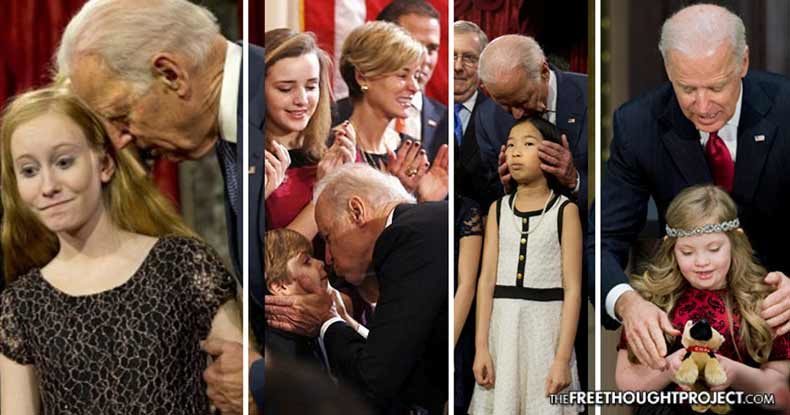
Creepy: Watch as Biden Jokes About Kindergarten Girl Being ‘Too Young To Resist’

Related image


One of my most enthusiastic wishes for outcomes in the Nov. 6 midterm elections is for the end of political double standards.
If you think about it, if everyone were held to the same standards of decency in speech and behavior, there would be a lot less division, and justice would be much more swift and consistent.
The double standard really does cause more conflict. Liberals often get away with doing and saying just about anything with little or no consequences.
A most recent example of this inequity is former Vice President Joe Biden and off-handed comments he made Tuesday about a kindergarten girl being “too young to resist.”
It was not only beyond creepy, but in the age of #MeToo, completely out of line in an abusively domineering kind of way.
TRENDING: Chelsea Handler Tells People To Use Deception To Ensure Multiple Votes

As Madison.com reported, Biden was in Wisconsin campaigning for Democratic Sen. Tammy Baldwin when he spoke to the crowd and endorsed State Schools Superintendent Tony Evers in his run for governor of the Badger State against conservative Republican Scott Walker.
In making his plug for Evers, Biden brought the candidate’s wife, Kathy, onto the stage, and the rest falls into the long history of Biden public gaffs.
“By the way, running for governor is a team sport! No way out,” Biden said. “He met Kathy in kindergarten. In kindergarten. She was too young to resist. She should’ve known better but she did it anyway.”
 
 
Grotesque doesn’t begin to describe how inappropriate that statement was. What started out to have been a sweet story of childhood sweethearts turned quickly into a suggestion of something adult and unseemly.
And the Democrats in the room laughed and applauded, accepting the statements without a thought of disapproval. What does that say about the state of double standards today?
Think back a few short weeks. Had someone like then-Supreme Court nominee Brett Kavanaugh made such a statement in mid-September, the liberal media would have set him on fire.
We would have seen wall-to-wall coverage of it for days, maybe weeks, and it would have received relentless scrutiny — possibly ending in calls for further investigation into his background searching for whatever manufactured claims of pedophilia liberals could create.
Biden has a history of gaffing it up. While not all of his actions were as creepy as the above statements, they do remain fairly outrageous for a seasoned politician.
RELATED: Twitter Was Given the Chance to Handle Bombing Suspect, But Dropped the Ball
This isn’t the first time we’ve noted Biden’s sometime eerie behavior around females. As a Conservative Tribune piece noted in November 2017, even liberals were getting creeped out by Biden in the age of the #MeToo movement.
Biden has a long history of stepping over the line in public on a lot of different topics, but his reputation as a groper is growing.
Maybe you can laugh off some of these incidents as accidental, but can you name one Republican that would receive that kind of pass at being such a creep?”


SOURCE
https://www.westernjournal.com/ct/creepy-biden-jokes-kindergarten/

What’s Wrong With the Democrats?


If the party cares about winning, it needs to learn how to appeal to the white working class.


Image result for What’s Wrong With the Democrats?


The strategy was simple. A demographic wave—long-building, still-building—would carry the party to victory, and liberalism to generational advantage. The wave was inevitable, unstoppable. It would not crest for many years, and in the meantime, there would be losses—losses in the midterms and in special elections; in statehouses and in districts and counties and municipalities outside major cities. Losses in places and elections where the white vote was especially strong.

But the presidency could offset these losses. Every four years the wave would swell, receding again thereafter but coming back in the next presidential cycle, higher, higher. The strategy was simple. The presidency was everything.
Listen to the audio version of this article:Feature stories, read aloud: download the Audm app for your iPhone.


Anyone who examined the strategy that the Democratic Party has embraced ever more tightly in recent years could see its essential precariousness. And anyone could see that investing such grave hopes in the person of Hillary Clinton—who had lost the party’s nomination to a little-known senator in 2008; who had struggled to win it against a little-known socialist eight years later—was particularly risky.

But liberals’ fears were softened in 2016 by a widely shared belief: that the candidacy of Donald Trump would shatter the Republican Party, at least in the form in which we had long known it. His trail of wreckage would force a painful reckoning with the party’s shortcomings—the narrowness of its coalition, the cloistered cluelessness of its elites, its intramural disagreements about the future of the nation. After a season of Trump’s destruction, the party would lie in rubble.

On November 8, that prophecy was realized, true in every regard, except that it described the Democrats. On Inauguration Day, the party’s power ebbed to its lowest level since the 1920s.

A year before his wife lost, Bill Clinton had a premonition of how things could go wrong. He revealed his foreboding at fund-raisers.

If there’s any consolation to the realization of terrible fears, of worst-case scenarios springing to life, it’s that they are invigorating. Donald Trump’s presidency has rocked a long-complacent Democratic Party like nothing in recent history. Liberals, with their confidence that the trajectory of the country points in their direction, never had quite as much practice as conservatives in expressing their anger. That’s what makes the "Resistance"—the many marches, the seething hostility at town-hall meetings, the anti-Trump placards shouting at passersby from bungalow windows—a transformational break in the pattern.


Leaderless and loud, the Resistance has become the motive power of the Democratic Party. Presidential hopefuls already strive to anticipate its wishes. Elected officials have restructured their political calculus to avoid getting on its wrong side. The feistiness and agitation of the moment are propelling the party to a new place.


But where? The question unnerves Democrats, because the party has no scaffolding. All the dominant leaders of the last two generations—the Clintons, Barack Obama—have receded. Defeat discredited the party’s foundational strategy—or, at the very least, exposed it as a wishful description of a more distant future, rather than a clear plan for victory in the present. Resistance has given the Democrats the illusion of unity, but the reality is deeply conflicted. Two of the party’s largest concerns—race and class—reside in an increasing state of tension, a tension that will grow as the party turns toward the next presidential election.

To produce a governing majority, the party will need to survive an unsettling reckoning with itself. Donald Trump didn’t just prevail over the Democrats; he called into doubt their old truths.

A year before his wife lost, Bill Clinton had a premonition of how things could go very wrong. He revealed his foreboding—perhaps fittingly—at fund-raising events. He would hint at what he considered his wife’s glaring vulnerability: the roiling discontent of the white working class. The travails of the group—44 percent of eligible voters—preoccupied him. He could recite one grim statistic after another. Even at this early date in the campaign, he knew that their cultural alienation might place them beyond the reach of a Democrat. And while most pundits at that point still considered Trump the second coming of Herman Cain, a circus act rather than a serious candidate, Clinton feared Trump’s ability to channel white-working-class rage. "He’s a master brander and he[’s] sensing sort of the emotional landscape of people he’s selling to," Clinton told donors gathered in Atlanta in October 2015.

Hillary Clinton always had trouble getting right with the zeitgeist, and her aides worried about that flaw. She began her first presidential bid as her party exploded in anger over the Iraq War, an adventure she had sanctified in the Senate. The specter of that vote and the campaign that followed, the fear that the political moment might again turn against her, continued to haunt her closest aides, especially Neera Tanden, the head of the Center for American Progress and one of her longest-standing advisers. Five months before the 2016 Iowa caucus, Tanden warned that Clinton would be punished for supporting banking deregulation—"the closest thing to an Iraq vote we have to face," she wrote her fellow members of the campaign’s inner sanctum. Her analysis proved wrong in the particulars, but broadly captured a central tension of the campaign. Some in Clinton’s camp could clearly see that a large chunk of the country seethed against elites, yet the candidate could never quite understand the need to insulate herself from the ire, much less harness it.

At first, the challenge of Bernie Sanders looked like a gift. All of the Democrats with big benefactors and well-tended reputations sensed the futility of running against Clinton, because she had started with imposing poll numbers, a well-funded apparatus, and the goodwill of a party that felt her loyal service to Obama merited reward. That left her facing a cantankerous, aging democratic socialist with a small following. Even Sanders—a luftmensch who ran his operation with about the same attentiveness he brings to getting dressed—seemed to doubt the potential of his own candidacy. A year before the first primary, he told Elizabeth Warren that he would cease his campaign preparations if she wanted to run. "He would have given her a clear lane," one former Sanders adviser told me. But Warren demurred. She had only recently arrived in the Senate, and it wasn’t hard to imagine a fusillade of Clinton-campaign attacks, an opposition-research file disgorged, leaving her too damaged for future fights.

Sanders, however, would prove a flummoxing rival. To win the Democratic presidential nomination, it helps to secure the African American vote. But another path to victory involves rallying white voters with a populist bent. This can create an uncomfortable dynamic in presidential primaries, where race vies with class to become the defining concern of the party. Politicians rarely vocalize the tension. But the socialism of Bernie Sanders—which hindered his efforts to explain the centrality of race to American life—made this split less subterranean than usual.

Of course, Hillary Clinton would have preferred to avoid an argument about the primacy of race versus class. But African American voters provided her the surest path to primary victory. They gravitated to her, in no small measure out of loyalty to Obama. Where Clinton posed as the president’s anointed successor, Sanders questioned Obama’s legacy and called for revolutionary change. He never dedicated himself to making meaningful inroads with African American or Latino voters, and so Clinton doubled down. After she lost New Hampshire in February, she began traveling with the grieving mothers of Trayvon Martin, Eric Garner, and other African American casualties of violence. Criminal-justice issues became an elevated feature of her standard pitch.

Clinton never met her crucial challenge: to both celebrate multiculturalism and also cushion the backlash against the celebration.

This was an inversion of the 2008 primary campaign. Desperately attempting to forestall Barack Obama by collecting wins in Appalachia, Clinton posed then as the tribune of "hardworking Americans, white Americans." But her reinvention last year followed the party’s prevailing wisdom. The Democrats had slowly transformed themselves since the 1960s, when working-class voters of every ethnicity had been reliable constituents. As the party had shed white southerners, it had trodden less tentatively on issues of race. And the swell of immigration that had begun with the Johnson administration’s liberalization of quotas had finally yielded enough citizens to lay a foundation for a cosmopolitan party. That direction suited white urban professionals, who considered themselves tolerant members of a globalized world. Working-class whites hadn’t been lost completely, of course; they remained important to the party in places like the upper Midwest, and unions, however shrunken, continued to provide support. But it was the mélange of minorities, Millennials, and white professionals that provided the basis for the so-called Obama coalition. And if Clinton had carried over any lesson from the 2008 race, it was the necessity of mimicking Obama’s tactics and methods, even if she sometimes produced only ersatz copies of them.


READ MORE HERE:


https://www.theatlantic.com/magazine/archive/2017/07/whats-wrong-with-the-democrats/528696/

Judicial Watch Sues FBI over Failure to Preserve Text Messages


Also Files Suit over Disgraced Official McCabe’s Texts
 
(Washington, DC) – Judicial Watch announced today that it filed lawsuits regarding the maintenance of text messages as federal records and for records of the audit of communications of former FBI Deputy Director Andrew McCabe.

After the FBI claimed that text messages are not subject to the Freedom of Information Act (FOIA) Judicial Watch filed suit to ensure that text messages are being preserved. The new Administrative Procedure Act lawsuit against the FBI challenges the FBI failure to preserve FBI text messages as required by the Federal Records Act. (Judicial Watch v. FBI (No.1:18-cv-02316)).

In its lawsuit Judicial Watch points to a related case in which Michael G. Seidel, the assistant section chief of the Record/Information Dissemination Section in the FBI’s Information Management Division, stated: "text messages on [FBI]-issued devices are not automatically integrated into an FBI records system." (Danik v. U.S. Department of Justice, (No. 1:17-cv-01792)).

Judicial Watch argued that the FBI "does not have a recordkeeping program in place that provides effective controls over the maintenance of electronic messages, including text messages." Moreover, "The FBI relies upon its personnel to incorporate their text messages into a recordkeeping system. If FBI personnel do not actively incorporate their text messages into a recordkeeping system, the text messages are not preserved."

Judicial Watch asked the court to declare the FBI’s failure to have a recordkeeping program for electronic messages to be "not in accordance with law" and that the court order the FBI "to establish and maintain a recordkeeping program that provides effective controls over the maintenance of electronic messages."

If text messages are not preserved, then they may be deleted and never produced to Congress, criminal investigators, and to the American people under FOIA.

Judicial Watch also filed suit against the Justice Department after the DOJ failed to respond to an August 27, 2018, FOIA request seeking the FBI’s audit records of McCabe’s communications (Judicial Watch v. U.S. Department of Justice (No. 1:18-cv-02283)).

In 2015, a political action committee run by Terry McAuliffe, a close friend and political supporter of Bill and Hillary Clinton, donated nearly $500,000 to Andrew McCabe’s wife Jill, who was then running for the Virginia State Senate. Also, the Virginia Democratic Party, over which McAuliffe had significant influence, donated an additional $207,788 to the Jill McCabe campaign. In July 2015, Andrew McCabe was in charge of the FBI’s Washington, DC, field office, which provided personnel resources to the Clinton email probe.

In July 2017, Judicial Watch filed three FOIA lawsuits seeking communications between the FBI and McCabe concerning "ethical issues" involving his wife’s political campaign; McCabe’s communications with McAuliffe; and McCabe’s travel vouchers.

Following an Inspector General Report, a grand jury reportedly was impaneled recently to investigate McCabe’s possible role in leaks to the media "to advance his personal interests."

The FBI has told Judicial Watch that it is under no legal obligation to produce any of Andrew McCabe’s text messages under FOIA, which has attracted criticism from President Trump.

"This lawsuit exposes a massive FBI cover-up of its text messages, which are government records and are, by the thousands, likely to have been deleted and lost by FBI employees," said Judicial Watch President Tom Fitton. "And of course, this cover-up conveniently impacts the production of text messages to Judicial Watch and Congress of disgraced FBI officials Andrew McCabe, Peter Strzok, Lisa Page and James Comey."

###


SOURCE:
 
 
https://www.judicialwatch.org/press-room/press-releases/judicial-watch-sues-fbi-over-failure-to-preserve-text-messages/

‘Terrible people’: Elon Musk losing faith in the press, says he has a ‘strong interest’ in the truth


Elon Musk went after the media for reporting "untruthful stuff" about him and his company.
"[M]y regard for the press has dropped quite dramatically," Musk said in an interview.
Recent coverage of Musk has been quite negative, to which he calls "outrageous."

Tesla and SpaceX CEO Elon Musk didn’t hold back his contempt for the press, calling out reporters for publishing what he called "untruthful stuff" about him and his company.

Musk said he did not consider the press the "enemy of the people" — a line often used by President Donald Trump — but the tech billionaire said journalists need to be "honest and truthful" in their writings.
"Well, I have to say, my regard for the press has dropped quite dramatically," Musk told Recode’s Kara Swisher in an interview released Friday.


"The amount of untruthful stuff that is written is unbelievable," Musk said. "Take that Wall Street Journal front-page article about like, ‘The FBI is closing in.’ That is utterly false. That’s absurd."

"To print such a falsehood on the front page of a major newspaper is outrageous. Like, why are they even journalists?" Musk said, adding: "They’re terrible. Terrible people."

Musk has come under increased scrutiny from the press in recent weeks. Musk’s problems started in August when he told Twitter followers he’d secured funding to take Tesla private, sparking a federal investigation into whether or not Musk misled investors.

Tesla and Musk eventually settled with the Securities Exchange Commission, agreeing to pay $20 million each. Musk told Swisher he’s since had to be more careful about what he tweets related to Tesla.

However, that didn’t stop the negative coverage. Reports suggested Musk was losing his grip on the company he helped found 15 years ago, and then, in October, The Wall Street Journal published reports that federal investigators were ramping up a criminal probe into Tesla.
 

WSJ reported that Tesla "received a voluntary request for documents from the Department of Justice about its public guidance for the Model 3 ramp." Investigators are looking into whether or not the company misled investors.

Musk pushed back on the negative coverage of Tesla during his interview with Swisher.

"I have a strong interest in the truth," Musk said. "Much more than journalists do."

Swisher compared Musk’s remarks to Trump’s on the media, but Musk shot down her concerns.

"The answer is for the press to be honest and truthful, and research their articles and correct things properly when they are false. Which they don’t do," Musk said.

"There are good journalists and there are bad ones, and unfortunately the feedback loop for good versus bad is inverted, so the more salacious that an article is, the more salacious the headline is, the more clicks it’s gonna get," Musk said. "Then somebody is not a journalist, they are an ad salesman. Not a journalist, an ad salesman."

SOURCE
https://www.bizpacreview.com/2018/11/02/terrible-people-elon-musk-losing-faith-in-the-press-says-he-has-a-strong-interest-in-the-truth-689824

Wednesday, October 31, 2018

5 freed from Gitmo in exchange for Bergdahl join Taliban’s political office in Qatar


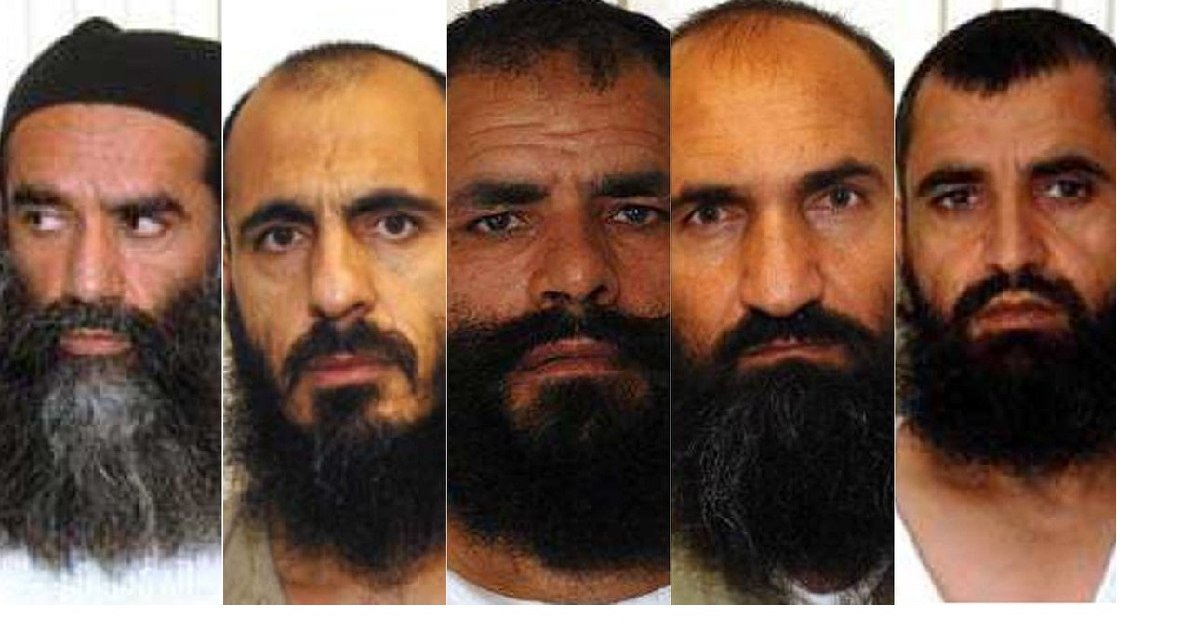
The five Guantanamo Bay detainees swapped for Sgt. Bowe Bergdahl are, from left, Mullah Norullah Nori, Mohammed Nabi Omari, Mohammed Fazl, Khairullah Khairkhwa and Abdul Haq Wasiq. (U.S. Department of Defense)


KABUL, Afghanistan — Five members of the Afghan Taliban who were freed from the U.S. military prison at Guantanamo Bay in exchange for captured American Army Sgt. Bowe Bergdahl have joined the insurgent group’s political office in Qatar, Taliban spokesman Zabihullah Mujahid said Tuesday.


They will now be among Taliban representatives negotiating for peace in Afghanistan, a sign some negotiators in Kabul say indicates the Taliban’s desire for a peace pact.


Others fear the five, all of whom were close to the insurgent group's founder and hard-line leader Mullah Mohammed Omar, bring with them the same ultra-conservative interpretation of Islam that characterized the group's five-year rule that ended in 2001 with the U.S.-led invasion.


The five Taliban figures released from the U.S. military prison at Guantanamo Bay in May 2014 in exchange for Army Sgt. Bowe Bergdahl, who was held hostage by the Taliban for nearly five years:


"The Taliban are bringing back their old generation, which means the Taliban have not changed their thinking or their leadership," said Haroun Mir, political analyst in the Afghan capital. "What we are more worried about is if tomorrow the Taliban say 'we are ready to negotiate,' who will represent Kabul? That is the big challenge because the government is so divided, not just ideologically but on ethnic lines."


Efforts to find a peaceful end to Afghanistan's protracted war have accelerated since Washington appointed Afghan-American Zalmay Khalilzad as envoy to find a peaceful end to America's longest war, which has already cost the U.S. more than $900 billion.


But Mohammed Ismail Qasimyar, a member of a government peace council, warned Washington against negotiating peace terms with the Taliban, saying Khalilzad’s only job is to set the stage for direct talks between the Afghan government and the Taliban, something the insurgents have so far refused, calling the government a U.S. puppet.


Taliban officials reported meeting with Khalilzad in Qatar earlier this month, calling the exchange preliminary but pivotal. Washington neither confirmed nor denied the meeting, but Khalilzad was in Qatar at the time.


Thousands of additional U.S. forces, new authorities and recent ceasefires give hope, general says.


A Taliban official familiar with the discussions told The Associated Press that talks ended with an agreement to meet again. Key among the Taliban's requests was recognition of their Qatar office, said the official, who spoke on condition he not be identified because he was not authorized to speak to the media.


In an unexpected development, Pakistan also bowed to a long-standing Afghan Taliban demand that it release its senior leader, Mullah Abdul Ghani Baradar, who had been in jail in Pakistan since 2010. At the time, Baradar was reportedly jailed after bypassing Pakistan to open independent peace talks with Hamid Karzai, who was then Afghanistan's president.


Baradar's release followed Khalilzad's first visit to Pakistan since being appointed Washington's peace envoy.


Baradar issued an audio message after his release to the Taliban. The Pashto-language message, heard by an Associated Press reporter, seemed to indicate he was preparing for a role in the insurgent movement moving forward.


Hakim Mujahed, a former Taliban member who is now also a member of the Afghan government peace council, said the presence of the five former Guantanamo prisoners in the Taliban's Qatar office is indicative of the Taliban's resolve to find a peace deal. He said the stature of the five within the insurgent movement will make a peace deal palatable to the rank and file, many of whom have resisted talks believing a military victory was within their grasp.


"These people are respected among all the Taliban," said Mujahed. "Their word carries weight with the Taliban leadership and the mujahedeen."


But there are some among the five who have a disturbing past.


Human Rights Watch accused Mohammed Fazl, the former Taliban army chief arrested in 2002, of overseeing the deaths of thousands of minority Shiites in 2000. The massacre outraged the world and followed the killing the year before of an estimated 2,000 young ethnic Pashtuns in northern Afghanistan by Taliban rivals.


Another of the five is Khairullah Khairkhwa, a former governor of Herat province, who was close to both Taliban founder Mullah Omar and al- Qaida leader Osama bin Laden. Khairkhwa also had a friendship with former president Hamid Karzai.


The others include Abdul Haq Wasiq, deputy intelligence minister, Mullah Norullah Nori, once described as the most significant Taliban leader held at Guantanamo Bay because of his particularly close relationship with Mullah Omar, who fought U.S.-led coalition forces in northern Afghanistan’s Mazar-e-Sharif and Mohammad Nabi Omari, a Taliban communications officer.


All five are from southern Afghanistan, the Taliban's heartland.


The five Taliban were released in 2014 in exchange for Bergdahl during the administration of President Barack Obama after drawn out negotiations.


Bergdahl, who had been held in Taliban custody since 2009 when he wandered off a U.S. army base, was given a dishonorable discharge last year and fined $1,000 on charges of desertion and misbehavior.


SOURCE:
https://www.militarytimes.com/news/your-military/2018/10/30/5-freed-from-gitmo-in-exchange-for-bergdahl-join-insurgents-in-qatar-taliban-says/?utm_medium=social&utm_source=twitter.com&utm_campaign=Socialflow+MIL

‘I know, they all look alike’: Hillary corrects host, who confused Booker and Holder, with a racial ‘joke’


Being a Democrat candidate appears to come with a “Get Out of Jail Free” card, as was seen over the weekend when Hillary Clinton joked that black people “all look alike.”


The failed 2016 Democratic presidential nominee was participating in a Q & A with Recode’s Kara Swisher, who asked, “What do you think of Cory Booker saying, ‘Kick them in the shins’?”


The question was a butchered reference to a recent comment from former Attorney General Eric Holder, who said when Republicans go low “we kick them.”


Clinton responded to remind Swisher that it was Holder who made the comment, not the senator from New Jersey.


“Well, that was Eric Holder,” she said, prompting Swisher to apologize.
“I know they all look alike,” Clinton countered, followed by a hearty cackle.


It goes without saying that if Clinton was a Republican, a grave would have been dug right there on the stage to lay her political career to rest — believe it or not, Clinton is floating the possibility that she may run again in 2020.


Instead, the liberal media played up the incident as a “tease” by Clinton.
Essentially justifying political correctness as little more than “politeness,” Clinton dared to talk about respecting diversity after cracking the racist joke.


“It’s respecting the diversity that we have in our society,” she continued. “The Democratic Party is a much more diverse political party, attracting people who are African-American, Latino, LGBT … And I don’t think it’s politically correct to say, we value that.”


“I don’t want to go around insulting people,” Clinton said. “I don’t want to paint with a broad brush every immigrant is this, every African-American is that. That’s childish.”


For the record, she made these remarks with a straight face.
Which is more than can be said for social media users, who were perplexed at how Hillary could pull this off with nary a scratch.


SOURCE AND VIDEOS HERE:
https://www.bizpacreview.com/2018/10/30/i-know-they-all-look-alike-hillary-corrects-host-who-confused-booker-and-holder-with-a-racial-joke-688617